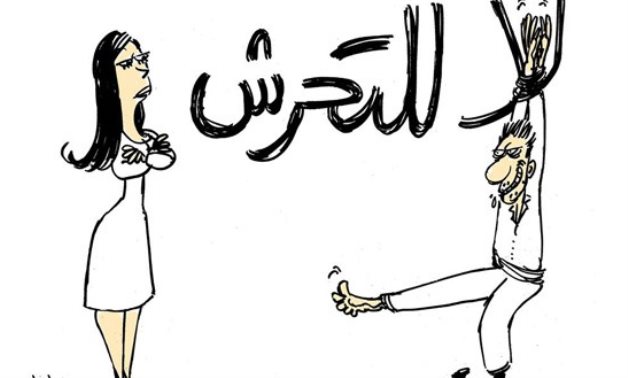
'La lel taharosh' No for sexual harassment - Photo courtesy of Doaa el-Adl
CAIRO - 31 March 2026: The Ministry of Endowments (Awqaf) has declared that electronic harassment comes among the most dangerous present-day crimes eating away at the fabric of society and troubling the consciences of the wise.
This deviant behavior involves intentional harm via digital platforms, such as social media platforms and email or chat applications, and includes inappropriate messaging and blackmail, leaking private data and manipulating to cause damage.
Sharia considers this act strictly prohibited because it violates humans’ honor and modesty while assaulting their dignity. Religious texts emphasize the protection of honor and strictly forbid anything that leads to its violation whether through words or actions or even subtle gestures.
The Ministry explains that harassment in all its forms, whether verbal, physical, or digital, is a sinful act that contradicts the goal of Sharia to preserve human dignity.
Islam is a religion of purity and both the Quran and Sunnah confirm the sanctity of human honor. It warns of severe consequences for those who harm others. Surah Al-Ahzab highlights that those who harm believers without justification carry the burden of clear sin.
Cyber-harassment causes deep moral and psychological pain which scriptures describe as a manifest sin. Scholars define this as a heinous act and a clear transgression because it targets humans’ honor and self-worth.
Prophet Muhammad described a true Muslim as the one from whose tongue and hand others are safe. He also taught that a Muslim’s blood, property, and honor are all sacred and forbidden to be violated by others.
Many wrongly believe that harassment behind a screen is less severe than real-life encounters but the Ministry calls this a grand delusion. Sin is not measured by where it occurs but by its impact.
The Prophet warned that the eyes and the tongue can commit their own versions of forbidden acts through improper looks or speech.
Screens do not change the nature of the sin nor do they lighten the burden of the guilt. In fact, the secrecy and ease of digital platforms may increase the danger because it allows for a wider circle of harm.
God has forbidden all paths leading to such indecency as this is an evil way to live.








Comments
Leave a Comment